
Security and accessibility are two critical considerations in the design of industrial machinery, vending equipment, storage cabinets, and utility enclosures. In many industries, equipment must remain securely closed during operation while still allowing authorized personnel to quickly access internal components for maintenance, servicing, or restocking. To meet these requirements, manufacturers often rely on mechanical locking solutions that combine durability, simplicity, and reliable performance.
One such widely used solution is the T-handle lock. Known for its distinctive handle shape and robust mechanical design, the T-handle lock has become a standard locking mechanism across a variety of industries. From vending machines and tool cabinets to electrical panels and vehicle compartments, T-handle locks provide dependable security while maintaining ease of use.
Unlike many modern electronic security systems, T-handle locks operate through a straightforward mechanical mechanism that does not rely on electricity or complex electronics. This makes them particularly valuable in environments where reliability, simplicity, and long-term durability are essential.
Another major advantage of T-handle locks is their compatibility with standard vending locks, allowing equipment manufacturers and operators to easily change the lock core and adjust the security level when necessary. This flexibility enables users to upgrade or replace locks quickly without replacing the entire handle assembly.
This article explores how T-handle locks work, their installation process, structural components, advantages, applications, and why they remain a preferred locking solution for industrial and commercial equipment worldwide.
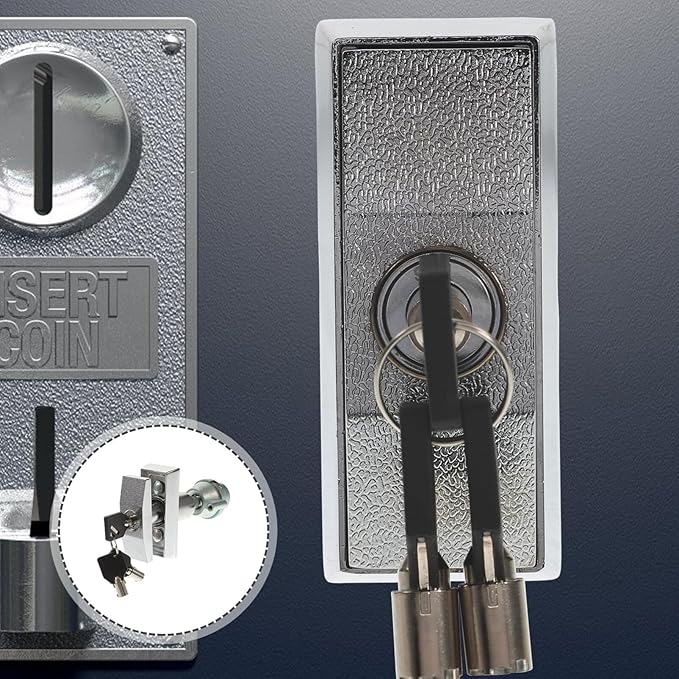
A T-handle lock is a mechanical locking device that combines a handle and a locking cylinder in a single integrated unit. The handle is shaped like the letter "T", which allows users to easily grip and rotate it when unlocking or opening a door, cabinet, or enclosure.
The T-shaped design is not only ergonomic but also practical, as it provides enough leverage to operate internal latching mechanisms. This makes it ideal for heavy-duty applications where standard key locks may not provide sufficient mechanical advantage.
T-handle locks are typically installed on doors, panels, or access covers that require secure closure. Once locked, the handle sits flush within the housing, preventing unauthorized operation. When the lock is opened using the correct key, the handle pops outward, allowing the user to rotate it and release the internal latch.
This pop-out mechanism improves both security and convenience by preventing accidental operation while also ensuring quick access for authorized users.
The operating mechanism of a T-handle lock is relatively simple but highly effective. Most designs rely on a combination of a vending lock cylinder, pop-out handle, and internal latching system to secure and release the enclosure.
The process typically works as follows:
When the lock is engaged, the T-handle remains recessed within the lock housing. In this position, the handle cannot rotate, and the internal latch remains securely fastened.
When a user inserts the correct key and unlocks the lock cylinder, the mechanism releases the internal latch that holds the handle in place. As a result, the handle pops outward, making it accessible for manual operation.
Once extended, the handle can be rotated or turned. This rotation activates the internal screw or cam mechanism that retracts the locking bolt or latch connected to the enclosure.
After the latch disengages, the door or panel can be opened.
To secure the enclosure again, the user simply closes the door, rotates the handle back to its original position, and pushes the handle into the housing. The locking mechanism automatically engages, securing the latch and preventing the handle from moving until the lock is opened again.
This mechanical process ensures secure closure while allowing quick and easy access when authorized.
One of the most important design features of T-handle locks is their compatibility with standard vending lock cylinders. These lock cylinders are widely used in vending machines, gaming equipment, kiosks, and other secure devices.
Because the lock cylinder is separate from the handle mechanism, manufacturers can produce self-contained T-handle assemblies that accept interchangeable lock cores.
This modular design offers several advantages.
First, it allows machine manufacturers to integrate the T-handle assembly into their equipment while choosing the appropriate lock cylinder based on security requirements.
Second, if the lock cylinder needs to be replaced or upgraded, it can be swapped out without replacing the entire handle assembly. In many cases, changing the lock cylinder takes only a few seconds.
Third, different manufacturers offer vending lock cylinders with varying levels of security. These include standard keyed locks, high-security tubular locks, and even electronic lock systems.
Because T-handle locks are compatible with many of these cylinders, equipment operators can upgrade the security level simply by installing a new lock cylinder.
This flexibility makes T-handle locks extremely versatile and adaptable to different applications.
A typical T-handle lock system consists of several key components working together to provide secure locking and smooth operation.
The handle is the most visible part of the lock. Shaped like the letter “T,” it provides an ergonomic grip that allows the user to easily rotate or pull the handle.
The pop-out design ensures that the handle remains flush with the lock body when locked, reducing the risk of accidental movement.
The lock cylinder is the component that accepts the key and controls the locking mechanism. It is typically installed in the front portion of the T-handle assembly.
Standard vending lock cylinders are commonly used because they are compact, durable, and widely available.
The latch mechanism is located at the rear of the lock assembly. When the handle rotates, the latch engages or disengages with the corresponding strike plate or locking point on the enclosure.
The housing contains the internal components of the lock and is mounted directly onto the door or panel.
The housing also provides structural strength, ensuring the lock can withstand repeated use and potential tampering attempts.
Installing a T-handle lock is generally a straightforward process, making it popular among equipment manufacturers and maintenance technicians.
The installation typically begins with preparing the mounting hole in the door or panel. The lock housing is then inserted through the opening from the exterior side.
On the front portion of the handle assembly, there is a round hole designed to accept the vending lock cylinder. The lock cylinder is inserted into this hole during installation.
At the rear of the pop-out handle, square holes are present. These holes interact with the latch mechanism and help secure the lock assembly.
Once the lock cylinder is inserted, the latch located at the end of the lock engages with the square hole inside the handle. This action secures the lock cylinder to the handle mechanism.
When the handle is pushed back into the lock housing, the latch extends into matching square holes within the body of the lock.
This engagement locks the handle firmly in place and prevents it from rotating or popping out.
When the correct key is used to unlock the cylinder, the latch retracts, releasing the handle and allowing it to pop outward. The user can then rotate the handle to open the door or panel.
This simple yet effective installation process makes T-handle locks easy to integrate into many different types of equipment.
T-handle locks offer several advantages that make them ideal for industrial and commercial applications.
Because they rely on mechanical components rather than electronics, T-handle locks are highly reliable and can operate for many years without failure.
The ergonomic T-shaped handle provides excellent grip and leverage, allowing users to easily open and close heavy doors or panels.
Thanks to the interchangeable vending lock cylinders, users can quickly replace or upgrade the lock core without removing the entire handle assembly.
Different lock cylinders provide varying levels of security, allowing users to choose the protection level that best fits their application.
Most T-handle locks are made from stainless steel, zinc alloy, or other corrosion-resistant materials, making them suitable for outdoor and industrial environments.
With few moving parts and simple mechanical operation, T-handle locks require minimal maintenance.
T-handle locks are used in a wide variety of industries and applications where secure access control is required.
T-handle locks are commonly used in vending machines to secure internal compartments containing products, cash, and electronic components.
Industrial electrical panels and control cabinets often use T-handle locks to protect sensitive equipment from unauthorized access.
Outdoor utility boxes and telecommunications cabinets frequently rely on T-handle locks because of their durability and weather resistance.
Truck toolboxes and service vehicle compartments often use T-handle locks for secure storage.
Many industrial machines include T-handle locks on maintenance panels and protective covers.
While traditional mechanical locks remain widely used, modern security technologies are gradually influencing the design of locking systems.
Manufacturers are now exploring electronic lock cylinders, RFID-enabled access systems, and smart locks that can integrate with digital security platforms.
However, even as electronic security systems become more advanced, mechanical locking solutions like T-handle locks will continue to play a vital role in many industries.
Their durability, simplicity, and reliability make them ideal for environments where electronic systems may not be practical or necessary.
Future designs may combine traditional mechanical mechanisms with modern electronic monitoring technologies, creating hybrid locking systems that offer both security and smart functionality.
The T-handle lock remains one of the most practical and reliable mechanical locking solutions used in industrial and commercial equipment today. Its simple yet effective design combines secure locking performance with convenient access, making it suitable for a wide range of applications.
By incorporating interchangeable vending lock cylinders, T-handle locks offer flexible security options that can be upgraded quickly and easily. Their robust construction and ergonomic operation ensure dependable performance even in demanding environments.
From vending machines and electrical cabinets to vehicle storage compartments and industrial machinery, T-handle locks continue to provide a trusted solution for secure access control.
As industries evolve and new technologies emerge, the proven reliability of T-handle locks ensures they will remain a valuable component of mechanical security systems for many years to come.